
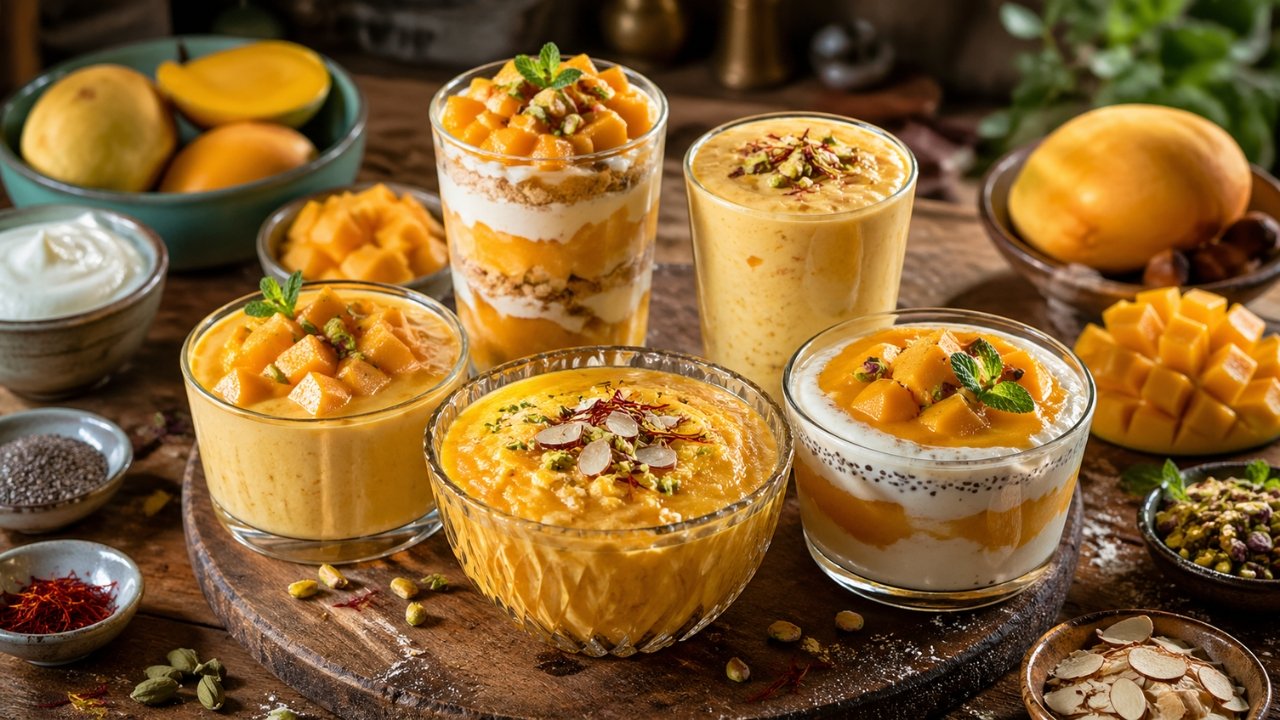
When the Indian summer settles in with its golden heat, dessert must feel generous without asking too much from the kitchen. This is the season for ripe mangoes, chilled cream, fragrant cardamom, soft curd, coconut, and the kind of sweets that refresh rather than overwhelm. These no-cook mango desserts are designed for exactly those afternoons when the air is warm, the fruit is at its fragrant best, and turning on the stove feels unnecessary.
As a chef, I find mango most expressive when it is handled gently. Heat can deepen it, certainly, but fresh mango has its own perfume: floral, honeyed, faintly resinous, and wonderfully lush. In these five desserts, the mango remains bright and natural, supported by textures that make each bowl or glass feel composed rather than casual.
Think of this as a summer dessert collection rather than one single recipe: a silky mango shrikhand, a tender biscuit parfait, a coconut mango mousse, chilled mango rabri-style cups, and a quick mango kulfi-inspired cream. Each one is no-cook, elegant, and deeply suited to hot Indian afternoons.
Recipe Information
- Recipe Name: 5 No-Cook Mango Desserts That Feel Perfect for Hot Indian Afternoons
- Description: A refined collection of five chilled mango desserts made without cooking, using ripe mangoes, cream, hung curd, coconut, biscuits, nuts, and gentle Indian aromatics.
- Servings: 10 small dessert portions, 2 portions of each variety
- Preparation Time: 45 minutes
- Cooking Time: 0 minutes
- Total Time: 45 minutes
- Chilling Time: 1 hour 30 minutes
- Difficulty: Easy to moderate
- Recipe Category: Dessert
- Cuisine: Modern Indian
Ingredients
For the mango base
- 5 large ripe Alphonso, Kesar, or Banganapalli mangoes, peeled and chopped
- 2 tablespoons powdered sugar, only if the mangoes need sweetness
- 1 tablespoon fresh lime juice
- 1 small pinch fine salt
For mango shrikhand cups
- 1 cup thick hung curd
- 3 tablespoons mango purée
- 2 tablespoons powdered sugar
- 1/4 teaspoon cardamom powder
- 1 tablespoon chopped pistachios
- A few saffron strands, crushed
For mango biscuit parfaits
- 8 digestive biscuits or nankhatai-style biscuits, crushed
- 1 tablespoon melted unsalted butter, optional
- 1/2 cup whipped cream
- 1/2 cup diced mango
- 2 tablespoons mango purée
For coconut mango mousse
- 1/2 cup thick coconut cream, chilled
- 1/2 cup whipped cream
- 4 tablespoons mango purée
- 1 tablespoon honey or icing sugar
- 2 tablespoons toasted coconut flakes, for garnish
For chilled mango rabri-style cups
- 3/4 cup thick fresh cream or malai
- 4 tablespoons mango purée
- 2 tablespoons finely chopped cashews and almonds
- 1/4 teaspoon cardamom powder
- 1 tablespoon rose water, optional
For quick mango kulfi-inspired cream
- 1/2 cup condensed milk
- 1/2 cup thick cream
- 1/2 cup mango purée
- 2 tablespoons chopped pistachios
- 1 pinch saffron or cardamom powder
Kitchen Tools
- Blender or food processor
- Mixing bowls
- Whisk or silicone spatula
- Small serving glasses, bowls, or kulhads
- Measuring cups and spoons
- Fine grater or small knife for garnishes
- Tray for chilling the desserts
Preparation
Preparing the mango base
- Choose the fruit carefully: Use mangoes that are aromatic at the stem and slightly soft when pressed. For no-cook mango desserts, the fruit carries the entire character of the dish, so avoid fibrous or under-ripe mangoes.
- Blend most of the chopped mango with lime juice and a pinch of salt until smooth. The salt should not be noticeable; it simply sharpens the mango’s natural sweetness and gives the purée a more rounded finish.
- Reserve some diced mango for layering and garnish. Keep the purée chilled while preparing the remaining components, as a cold mango base gives every dessert a cleaner, more refreshing texture.
Making the mango shrikhand cups
- Place the hung curd in a bowl and whisk until smooth and glossy. If it looks grainy, pass it through a fine sieve or beat it patiently with a spoon for a minute.
- Fold in mango purée, powdered sugar, cardamom, and crushed saffron. Texture check: The shrikhand should be thick enough to hold soft swirls but not stiff like buttercream.
- Spoon into small bowls and finish with pistachios. Chill before serving so the saffron and cardamom settle into the dairy.
Layering the mango biscuit parfaits
- Combine crushed biscuits with melted butter if you want a more compact crumb. For a lighter parfait, use the biscuits plain; they will soften slightly against the cream.
- Add a spoonful of biscuit crumbs to the base of each glass, followed by whipped cream, mango purée, and diced mango. Repeat once more for a neat layered look.
- Tip: Do not press the biscuit layer too firmly. A loose crumb gives a more delicate spoonful and prevents the parfait from feeling heavy.
Whipping the coconut mango mousse
- Whisk chilled coconut cream until it becomes smooth and slightly airy. Fold in whipped cream, honey, and mango purée using gentle strokes.
- The mousse should look softly clouded, not perfectly uniform. A few pale golden streaks of mango make it feel handmade and elegant.
- Spoon into small glasses and garnish with coconut flakes just before serving. This version is especially lovely when served very cold.
Composing the rabri-style mango cups and kulfi-inspired cream
- For the rabri-style cups, stir cream with mango purée, cardamom, nuts, and rose water. Note: This is not traditional rabri, which is reduced over heat, but a no-cook summer interpretation with the same luxurious intention.
- For the kulfi-inspired cream, whisk condensed milk, thick cream, mango purée, and saffron or cardamom until smooth. Spoon into small kulhads or glasses and top with pistachios.
- Chill both desserts until cold. They should be creamy and spoonable, not frozen solid, unless you prefer to set the kulfi-style mixture briefly in the freezer for a firmer texture.
Serving Suggestions
Serve these desserts in small portions, ideally in a mixed platter of glasses, bowls, and earthen kulhads. The beauty of these no-cook mango desserts lies in contrast: one spoonful tangy with hung curd, another soft with cream, another fragrant with coconut or saffron.
For a polished presentation, keep garnishes restrained. A sliver of mango, a pinch of pistachio, a few coconut flakes, or one saffron strand is enough. These desserts are best served cold, brought out just a few minutes before eating so the textures remain fresh and defined.
They are particularly suited to summer lunches, mango parties, festive family meals, or quiet late-afternoon treats with masala chai served separately. Because the desserts are rich but not cooked, they retain a breezy, seasonal lightness.
Chef Tips
Balance sweetness with acidity
Mango varies greatly from fruit to fruit. Taste the purée before adding sugar. A few drops of lime juice can make an overly sweet mango taste more vibrant, while a little sugar can soften a mango that is fragrant but not fully sweet.
Use thick dairy for clean structure
Watery curd or thin cream will loosen the desserts too much. Hung curd, chilled coconut cream, thick malai, and well-whipped cream create the spoonable textures that make these mango desserts feel refined rather than improvised.
Keep the portions modest
In hot weather, dessert should refresh the palate, not exhaust it. Small glasses allow each variation to feel special, and they make this collection easy to serve at gatherings.
Storage and Make-Ahead Tips
These desserts can be prepared up to one day ahead and kept covered in the refrigerator. Add crunchy garnishes, biscuit crumbs on top, toasted coconut, and fresh mango pieces close to serving so they retain their texture.
The shrikhand cups and kulfi-inspired cream hold especially well overnight. The biscuit parfaits are best eaten within 6 to 8 hours, as the crumb softens with time. The coconut mousse should be kept chilled and served the same day for the freshest flavour.
Avoid leaving these desserts at room temperature for long periods, particularly in Indian summer heat. If serving outdoors, arrange them over a tray of ice or bring them out in small batches.
Additional Information
Mango has a special place in Indian summer cooking, not merely as a fruit but as a seasonal ritual. From aamras in Gujarat and Maharashtra to mango shrikhand, kulfi, lassi, and chilled fruit creams served across homes and clubs, it marks the generous heart of the hot months.
This collection takes inspiration from those familiar flavours and presents them in a modern, no-cook format. There is no attempt to disguise the mango or complicate it unnecessarily. Instead, each dessert frames it differently: with tang, creaminess, crunch, fragrance, or cool richness.
That is why these no-cook mango desserts feel so right for hot Indian afternoons. They respect the season, save the cook from the stove, and let ripe mango do what it does best: bring colour, perfume, and quiet luxury to the table.